Why Does My Baby Push Backwards While Feeding
 If you have a baby that oftentimes has an arched back and is crying when you hold her, or she is straightening her legs and screaming, it is piece of cake to go worried. Notwithstanding, crying is a completely good for you and normal behavior for newborn infants. For nigh newborns, arching their backs and crying is perfectly fine and par for the form.
Peculiarly in the first several months of historic period, a baby cries in order to verbally communicate with his or her parents. Equally babies grow, they quickly develop other exact and non-exact communication tools, only early on on, crying is the merely constructive tool infants have to talk to their parents.
Not all crying is the aforementioned. Infants deploy different types and levels of crying to communicate different things. Some crying is meant to signal that the baby is hungry. Other types of crying are meant to point pain or discomfort. New parents usually pick upward on these subtle crying differences very quickly.
Newborn infants volition oft cry because they are in discomfort or balmy pain. Newborns accept gas and other things that bother them, so pain crying is nothing to worry well-nigh. Withal, in rare cases, there is one particular type of "hurting crying" that is cause for concern: arched back crying. If a babe appears to be arching its back while crying intensely or straightening her legs and screaming at nighttime, it COULD exist a sign of something abnormal. Back arching is a mutual reflex that babies exhibit when they endure from very acute or stiff pain.
And then if a infant is flexing her dorsum when she cries, it may exist more than just the normal baby pains. Can baby back arching (with or without crying) exist cause for concern? In an extremely small number of cases, arching the back is likewise an early on symptom of spastic cerebral palsy, jaundice, autism, and other serious complications or signs of injury.
If you are concerned, read on. But remember the odds are overwhelming that there is nothing wrong with your baby. (Don't skip past that final sentence. Assimilate it.)
- How to soothe a crying baby (what the medical literature tell united states)
- Symptoms of brain impairment in a newborn
- A video explaining reasons why your baby may be crying with an arched back.
Possible Concerning Causes of Arched Back Crying
Anything that causes a baby to experience meaning pain or discomfort can trigger biconvex back crying. Your healthcare provider volition perform diagnostic testing to determine what is causing your infant's hurting. Beneath is a list of some potential triggers. Go along in mind that the less serious causes are more than likely.
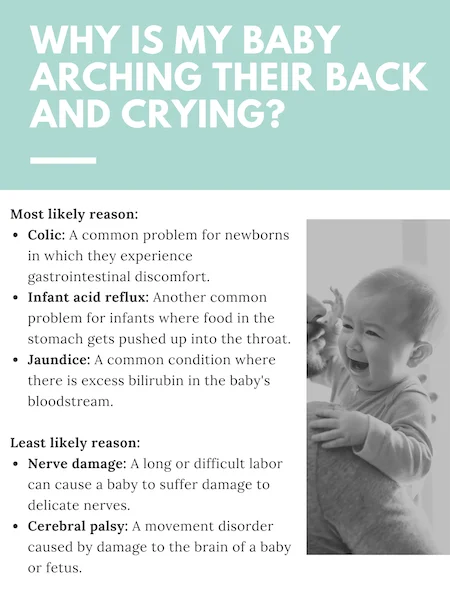
- Colic : Colic is a common problem for newborn babies. It is a broad term used to describe gastrointestinal discomforts in infants. No 1 really knows exactly why or how colic occurs, but we practice know that it has to do with the fact that infants have immature digestive systems that tend to be overly sensitive. Private cases of colic can range from mild to very severe. Babies were astringent colic tin can showroom intense pain on a regular footing. Colic commonly goes away as the baby develops. Colic is the nigh likely cause of arched back crying.
- Infant Acid Reflux : Gastroesophageal reflux (commonly chosen "acid reflux" or "GERD") is another common trouble for newborn babies. Simply like acid reflux in adults, infant acrid reflux happens when nutrient (for infants breast milk or formula) in the stomach gets pushed back upwards into the pharynx and esophagus. The reflex that pushes the nutrient dorsum upward, involving the lower esophageal sphincter muscles, is uncomfortable itself, and the refluxed food or milk is mixed with stomach acid that burns the inside of the throat. In adults, acid reflux is unremarkably merely a minor discomfort, not something specially painful. In newborns, however, reflux can be extremely uncomfortable and even painful. Infant GERD is besides a probable cause of arched dorsum crying, especially if the baby cries almost often after feeding. At that place is at to the lowest degree one study that suggests chiropractic care can help these babies.
- Nerve Harm : During a long or hard vaginal commitment, babies ofttimes suffer damage to their fragile nerves. The nerves in babies' shoulders are particularly vulnerable during vaginal delivery. When nerve damage during delivery is very significant, it tin issue in permanent injuries such as Erb's Palsy. Minor nervus damage or pinched fretfulness suffered during vaginal commitment can trigger acute pain along the infant's neck and dorsum. This shooting hurting is a potential trigger of dorsum arching and pain crying.
- Jaundice/Kernicterus : Jaundice is a common condition that most newborns experience to some degree. It is caused past excess levels of bilirubin (a waste product product of cherry blood cell pause down) in the baby'south bloodstream. Jaundice itself is not painful, all the same, it tin can become dangerous if not treated. Eventually, astringent jaundice can lead to kernicterus, a rare type of encephalon damage caused past excess bilirubin. When jaundice starts to progress to this threatening stage, babies reportedly experience intense pain along their spine. If a baby has severe jaundice, arched back crying is often viewed as an early clinical symptom of kernicterus.
- Autism: It is impossible to diagnose autism in a newborn. But it is true that symptoms such as excessive drooling and arching her back when held are symptoms that are more common in autistic babies. But, once again, and you take to remember this, these are common in perfectly normal newborns every bit well.
- Cerebral Palsy : Cognitive palsy is a movement disorder caused past damage to the developing brain of a baby or fetus. The injury impairs the encephalon's ability to control and coordinate muscle movements in the body through impulse signals. There are several different types of cerebral palsy. The predominant type of cognitive palsy is spastic CP, which is characterized by involuntary muscle contractions and rigidity. Back arching in newborn babies is one of the earliest signs of involuntary muscle contractions in children with spastic CP.
What a Infant Arching Her Back Likely Ways
Parents are alarmists. The proclivity to overreact comes with the job. It is not a bad affair. Information technology keeps you lot vigilant. If you have a infant arching her back, go along an heart on it. But keep information technology in context too. The overwhelming likelihood is that you have a normal, happy, and healthy baby.
mcbroomsuppen1991.blogspot.com
Source: https://www.birthinjuryhelpcenter.org/baby-crying-arched-back.html
0 Response to "Why Does My Baby Push Backwards While Feeding"
Publicar un comentario