identify the three goals of a project. what does it mean for a project to be "overdetermined?"
The performance of a project, normally called its "efficiency," is assessed on the basis of iii criteria, variously known every bit the "triple constraints," the "iron triangle," the "golden constraints," and then on. Is the project on fourth dimension or early? Is the project on or nether upkeep? Does the project deliver the scope to the agreed-upon specification? Figure one-one shows the three goals of a project specifications. The operation of the project and the PM is measured by the degree to which these goals are achieved. A contempo outcome, however, has arisen: meeting a projection'southward triple constraints often does not attain the aims of the project for the customer, known as the project'southward "effectiveness;" that is, the projection didn't deliver the benefits the client was hoping to proceeds. Notwithstanding, not meeting the projection's triple constraint usually dooms the project to failure. This event is discussed further in Section i.five.
One of these goals, the projection'southward specifications or "scope," is fix primarily by the client (although the client agrees to all three when contracting for the project). It is the customer who must make up one's mind what capabilities are required of the project's deliverables—and this is what makes the projection unique. Some writers insist that "quality" is a divide and distinct goal of the project along with time, cost, and scope. Nosotros practice not concur because we consider quality an inherent function of the projection telescopic.
If we did not alive in an uncertain globe in which best made plans often go awry, managing projects would be relatively simple, requiring only careful planning. Unfortunately, we exercise not live in a anticipated (deterministic) world, but one characterized by chance events (uncertainty). This ensures that projects travel a rough road. White potato's law seems as universal every bit decease and taxes, and the outcome is that the most skilled planning is upset by uncertainty. Thus, the PM spends a great bargain of time adapting to unpredicted modify. The primary method of adapting is to merchandise off 1 objective for another. If a construction project falls behind schedule because of bad weather, information technology may be possible to get dorsum on schedule by calculation resources—in this case, probably labor using overtime and mayhap some additional equipment. If the budget cannot exist raised to cover the additional resources, the PM may take to negotiate with the customer for a later delivery date of the building. If neither cost nor schedule can exist negotiated, the client may be willing to cutting dorsum on some of the features in the building in order to allow the project to finish on fourth dimension and budget (e.g., substituting carpet for tile in some of the spaces). As a final alternative, the contractor may have to "consume" the added costs (or pay a penalty for late delivery) and take lower profits.
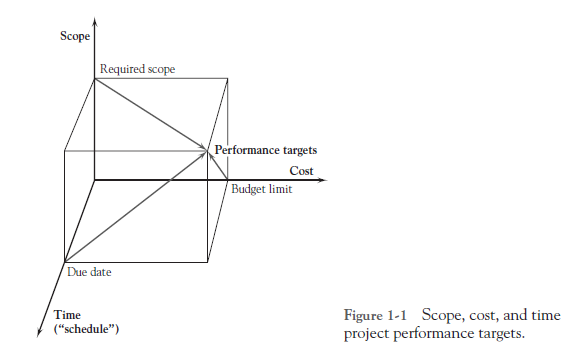
This example illustrates a cardinal betoken. Namely, managing the trade-offs among the iii project goals is in fact 1 of the principal roles of the project manager. Furthermore, managing these trade-offs in the near effective mode requires that the projection manager have a clear understanding of how the projection supports broader organizational goals. Thus, the organization's overall strategy is the virtually important consideration for managing the merchandise-offs that will be required amid the three project goals.
All projects are ever carried out under conditions of uncertainty. Well-tested software routines may not perform properly when integrated with other well-tested routines. A chemical compound may destroy cancer cells in a exam tube—and fifty-fifty in the bodies of examination animals—only may impale the host also equally the cancer. Where one cannot find an acceptable manner to deal with a problem, the just alternative may be to finish the project and start afresh to accomplish the desired deliverables.
As we note throughout this book, projects are all about doubt. Therefore, in addition to effectively managing trade-offs, the second major role of the project manager is dealing with incertitude, that is, managing risks. The fourth dimension required to consummate a project, the availability and costs of key resource, the timing of solutions to technological problems, a wide diversity of macroeconomic variables, the whims of a customer, the deportment taken past competitors, even the likelihood that the output of a projection volition pergrade as expected, all these exemplify the uncertainties encountered when managing projects. While there are actions that may be taken to reduce the uncertainty, no deportment of a PM can ever eliminate it.
Every bit Hatfield (2008) points out, projects are complex and include interfaces, interdependencies, and many assumptions, whatsoever or all of which may turn out to be wrong. Also, projects are managed by people, which adds to the uncertainty. Gale (2008a) reminds united states of america that the uncertainties include everything from legislation that tin can change how we do business concern, to earthquakes and other "acts of God." Therefore, in today'south turbulent business environment, effective decision making is predicated on an ability to manage the ambiguity that arises while we operate in a earth characterized by uncertain information. (Hazard management is discussed in Chapter 11 of the PMBOK, fifth ed., 2013.)
The first step in managing risk is to place these potentially uncertain events and the likelihood that any or all may occur. This is called take chances analysis. Different managers and organizations arroyo this problem in dissimilar ways. Gale advises expecting the unexpected; some managers suggest considering those things that proceed one awake at dark. Many organizations go along formal lists, a "risk annals," and use their Project Management Role (PMO, discussed in Chapter 2) to maintain and update the listing of risks and approaches that take been successful in the past in dealing with specific risks. This information is then incorporated into the business firm'south business organization-continuity and disaster- recovery plans. Every organisation should have a well-divers procedure for dealing with adventure, and nosotros will discuss this issue at greater length in Section 3.5. At this point we merely overview risk analysis.
The essence of risk analysis is to make estimates or assumptions about the probability distributions associated with cardinal parameters and variables and to use analytic conclusion models or Monte Carlo simulation models based on these distributions to evaluate the desirability of certain managerial decisions. Real-world problems are usually large enough that the use of analytic models is very difficult and time consuming. With mod computer software, simulation is non difficult.
A mathematical model of the situation is synthetic that models the human relationship between unknown input variables and important outcomes. The model is run (or replicated) repeatedly, starting from a unlike point each time based on random choices of values from the probability distributions of the input variables. Outputs of the model are used to construct statistical distributions of outcomes of involvement to decision makers, such as costs, profits, completion dates, or render on investment. These distributions are the chance profiles of the outcomes associated with a determination. Risk profiles tin be analyzed by the manager when considering a decision, along with many other factors such as strategic concerns, behavioral issues, fit with the system, price and scheduling issues, and and so on.
Thus in this book, we adopt the point of view that the 2 primary roles of the project manager are managing trade-offs and managing risks. Because these two roles are primal to the piece of work of the project manager, icons are displayed throughout the book in the left margin when these topics are discussed. It is also important to point out that these ii roles are highly integrated with one another. Indeed, managing hazard is really tightly coupled with managing the three traditional goals of projection management. For case, the more doubtfulness the project manager faces, the greater the gamble that the projection volition get over upkeep, end tardily, and/or non meet its original scope. Notwithstanding, beyond these rather obvious relationships, at that place is also a more than subtle connection. In item, project adventure tin actually exist idea of equally a quaternary merchandise-off opportunity at the project manager's disposal. For example, the project's budget can exist increased in order to collect additional information that in turn will reduce the uncertainty related to how long it volition take to complete the projection. Besides, the projection's deadline can be reduced, but this volition increase the uncertainty nearly whether it will be completed on time.
Virtually of the trade-offs PMs make are reasonably straightforward if the organization's strategy is well understood and trade-offs are discussed during the planning, budgeting, and scheduling phases of the project. Usually they involve trading time and cost, but if we cannot alter either the schedule or the upkeep, the scope of the project may exist altered or additional risk accepted. Frills on the finished product may exist foregone, capabilities not badly needed may be compromised. From the early stages of the project, information technology is the PM's duty to know which elements of projection performance are sacrosanct.
1 concluding annotate on this subject field: Projects must have some flexibility. Again, this is because we practise not alive in a deterministic world. Occasionally, a senior manager (who does not take to manage the project) presents the PM with a certificate precisely listing a set of deliverables, a fixed budget, and a firm schedule. This is failure in the making for the PM. Unless the budget is overly generous, the schedule overlong, and the deliverables easily accomplished, the arrangement is, as mathematicians say, "overdetermined." If Mother Nature so much every bit hiccups, the project will neglect to meet its rigid parameters. A PM cannot be successful without flexibility to manage the trade-offs.
Source: Meredith Jack R., Mantel Jr. Samuel J., Shafer Scott M., Sutton Margaret Thousand. (2017), Projection Management in Practice, John Wiley & Sons, Inc. 3th Edition.
mcbroomsuppen1991.blogspot.com
Source: https://phantran.net/what-is-managed-the-three-goals-of-a-project/
0 Response to "identify the three goals of a project. what does it mean for a project to be "overdetermined?""
Publicar un comentario