Judith Renaissance Painting Man With Chopped Off Head Art Institute of Chicago
Violence and Virtue on Display at the Art Institute of Chicago
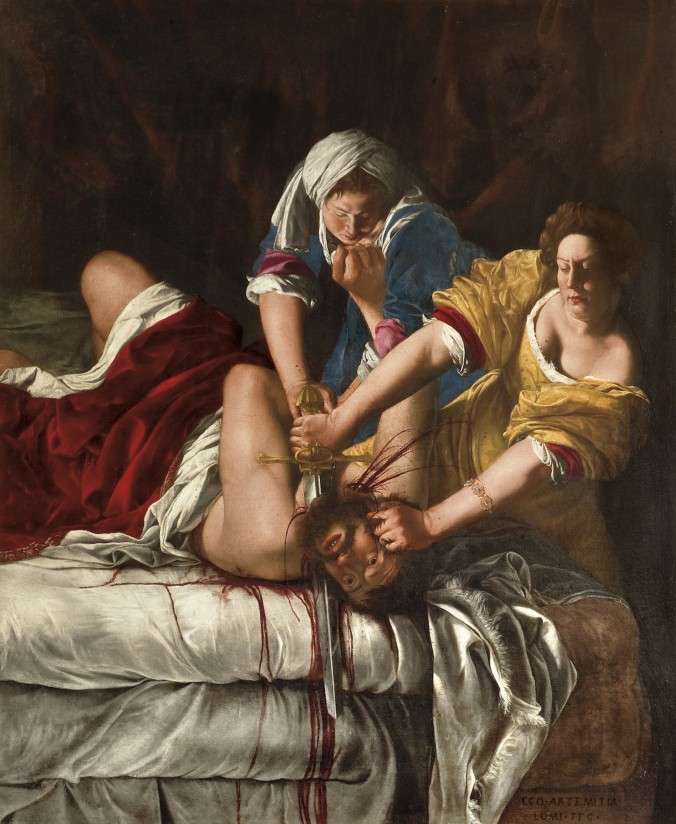
Artemisia Gentileschi. Judith Slaying Holofernes, c. 1620. Galleria degli Uffizi, Florence, inv. 1567. Epitome courtesy of the Art Institute of Chicago.
Violence and Virtue: Artemisia Gentileschi's "Judith Slaying Holofernes"
October 17, 2013 – January nine, 2014
The Art Institute of Chicago
"Violence and Virtue," an exhibition at the Art Plant of Chicago is a unique opportunity to see Artemisia Gentileschi'southward masterpiece Judith Slaying Holofernes (1611-12), which is normally displayed in Galleria degli Uffizzi in Florence, Italy. Gentileschi's painting is shown along with other artwork focusing on the grapheme of Judith, the biblical-legendary Jewish heroine. Prints and paintings tell the story of Judith to viewers, and permit them to compare how different artists approached the same topic over the course of history.
"The Book of Judith" is included in the Catholic and Eastern Orthodox Christian Old Attestation, and excluded from the Hebrew Bible and about Protestant Bible editions equally a non-approved form of apocrypha. This story is an example of feminine power in a patriarchal world, as Judith, a virtuous widow, seduces Holofernes, a commander of the enemy's ground forces, in order to cut off his head. Judith's character is outstanding because of her ambivalence. The Bible describes her every bit an ideal, a brave and god-fearing woman, only in the context of more contemporary moral values (Judith's human activity seemed perfectly fine for ancient Hebrew state of war ethics) her actions seem violent and rebellious.
For some male artists approaching the subject area, the figure of a woman who leads a man to downfall using her dazzler and wits, and is furthermore praised for this deed by her fellow countryman, was both horrifying and fascinating. In the nineteenth century, the violent and seductive Judith became a perfect example of femme fatale and was depicted exactly so in the famous Gustav Klimt'south painting Judith and the Caput of Holofernes (1901). At the exhibition in the Art Constitute, Sanders van Hemessen'south Judith (1540) represents the heroine in a similar way, though both paintings are much older than the concept of the femme fatale. Judith is shown naked and determined, with her sword raised upwardly in a triumphant fashion. Nudity, withal, is not mentioned anywhere in the Volume of Judith. In fact, the story emphasizes that Holofernes brutal asleep quickly and his plan to copulate with the beautiful widow never succeeded, thus leaving Judith'due south virtue intact. Despite this fact, endless artists used her nudity equally a tool to prove the heroine's sexuality and propose information technology was a course of charade she used to kill the commander. Another case of this fascination with Judith and nudity is Hans Beham's print Judith and Her Servant, in which both Judith and her servant Abra are naked, which does not occur in the original story, because Abra did not seduce Holofernes and had no reason to take off her clothes.
Although cutting off the head of a sleeping man seems horrifying (especially while looking at Gentileschi's violent painting), Judith did this in order to salve lives of all people in her hometown and prevent the temple in Jerusalem from being destroyed. The Book of Judith emphasizes this, suggesting that Judith saved the faith of all Israelites, every bit Holofernes planned to forcefulness them to worship his male monarch instead of their God. This approach to her actions gives the heroine a sense of sacredness. Some scholars also state that Judith may be an apologue for all religious people in Israel, as her proper name etymologically means "Jewess" in Hebrew. Many historical facts mentioned in the book are incorrect, similar Assyrian army trying to force the Hebrews to worship their king, because Assyrians usually allowed religious liberty on conquered lands. This makes the story a parable that emphasizes moral values rather than a description of bodily historical facts.
In contrast to the image of Judith created past van Hemessen, the prints of the artist Jacopo de Barbari depict the "sacred" image of Judith. Barbari's Judith is fully clothed and more traditionally feminine looking. Gentle lines are used to draw her figure. She holds Holofernes' head with delicacy and turns away her optics, as if she is pitying her victim. She is presented every bit if she was just obeying God'south will, rather than committing the act with passion. On the reverse, van Hemessen's Judith is more active, masculine in her muscularity, and triumphant. These two pieces of art excellently testify two sides of Judith: the violent and the virtuous.
Artemisia Gentileschi'south painting Judith Slaying Holofernes (1614-xx) is a central focus of the exhibition. It stands out from the other displayed pieces in its behemothic size (67 in x 53.5 in) and is a naturalistic, if non violent, depiction of the murder. Other exhibited paintings and prints unremarkably depict Judith subsequently her act, holding the head of Holofernes, or hiding information technology in a sack. These other representations of the topic do not expose brutality of the human activity. On the contrary, Gentileschi's piece depicts the most lurid moment of his decapitation. Holofernes' head is half cut off, his eyes are still open, and blood is spurting from his neck. The dynamic and dramatic scene is typical for the Bizarre Period, that Gentileschi's masterpiece comes from. Bizarre style put a strong accent on shocking and engaging the audition'due south feelings through emotionally stimulating scenes. Baroque artists were also inspired past theater: they used narrative, dynamism, and illusion in their piece of work. This style is different from many of the Late Renaissance artist's pieces included in the exhibition that preferred creating more static scenes.
Gentileschi'southward Judith Slaying Holofernes was strongly influenced past Caravaggio'southward Judith Beheading Holofernes (1598-1599 ). Their paintings share very similar qualities such equally their option of colors and usage of chiaroscuro lighting with deep contrasts of light and shadow. At that place are besides similarities in their renditions of Judith's gestures (like the way she holds Holofernes' hair), and their depiction of the decapitation moment. Gentileschi painted her version of Judith's story about twenty years subsequently Caravaggio and has been described as a Caravaggisti or a stylistic follower of Caravaggio'due south style. This style became fashionable in European Baroque painting, and the high demand for artwork similar to Caravaggio'south encouraged artists to paint in his style. Orazio Gentileschi, Artemisia's father from whom she learned painting was also the caravaggisti.
Judith's act was a very popular choice of subject matter during the Renaissance and Baroque periods and her figure even appeared every bit a decorative element on plates (one of them is a function of the exhibition). In many ways, painting Judith in Caravaggio's style must accept been a commercial success for Artemisia, who made a living from her paintings. There is a theory that the fashionable and expensive clothes worn past Judith in the painting was placed at that place, considering the Medici family (famous Florentine patrons of art) favored pieces of art that depicted luxury. Gentileschi created a series of four paintings focused on Judith, including a 2nd version of Judith Slaying Holoferne s (on display in National Museum of Capodimonte, Naples) so she might have institute the subject affair profitable.
However, her motivation for painting these passionate masterpieces was stronger than just meeting patron'due south demands. Artemisia's tutor, Agostino Tassi, was accused in court of raping her, so such a violent depiction of decapitation of Holofernes could exist considered as the artist's response to sexual violence she experienced. The fine art earth was dominated by men in the seventeenth century, so Artemisia's career was a constant struggle with gender prejudice. Female painters were treated equally a "curiosity" rather than as an equal to their male counterparts. Every bit Judith was a successful adult female in a guild dominated by men, Artemisia probably found her story compelling. The effort to gain ability in a patriarchal environment might explicate why Gentileschi painted Judith in a more vehement way than about other artists did. Different Caravaggio, Artemisia did not depict moral ambiguity of the heroine, and focused instead on her cruel triumph over the tyrant. She besides resigned from a traditional representation of Abra as a passive onetime adult female, which artists often used as a contrast to Judith's appearance to emphasize heroine'south chastity and beauty. Gentileschi instead painted her as a young woman, actively involved in the act of decapitation. Therefore, in Gentileschi's painting, Abra appears to be Judith'southward friend, rather than just her servant.
"Violence and Virtue" focuses on two women emancipated in their times: Judith, and Artemisia Gentileschi. In the Book of Judith, the heroine non but won a war for her country, but also was highly esteemed by club, as she managed the properties of her belatedly husband and never remarried despite having many suitors. Artemisia Gentileschi managed to be a successful painter (both artistically and commercially) and through her depiction of Judith's triumph, she represented her own success every bit an artist. Although the times have changed, Judith and Artemisia's power is withal inspiring and fascinating.
mcbroomsuppen1991.blogspot.com
Source: https://fnewsmagazine.com/2013/11/the-power-of-judith-and-artemisia/
0 Response to "Judith Renaissance Painting Man With Chopped Off Head Art Institute of Chicago"
Publicar un comentario